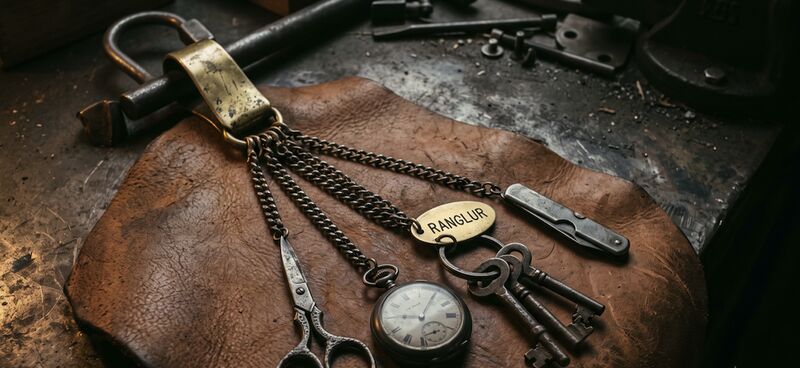
Before pockets, the keeper of a castle wore the keys.
Not in a drawer. Not in a vault. On the body with a single clip at the waist, and from it a fan of chains carrying every key to every locked room in the household.
They called it a chatelaine.
The word means keeper of the castle. The device was named for the office, not the object.
Read it as Protective Infrastructure, and it stops being quaint.
Every key on one carrier is consolidation. It is also concentration. Those are the same decision seen from two sides.
The chatelaine put every access tool at hand, and put every access tool at a single point of failure. Lose the clip, lose the castle. And because the keys were physical, recovery meant re-keying every lock in the house.
Three centuries later, we rebuilt the chatelaine and called it a phone. One carrier. Every credential for the door, the car, the gate, the safe. The convenience argument has not changed since 1751. Neither has the concentration risk.
One thing changed. The revocation layer. A lost token can be killed remotely and reissued in minutes. That is the real advance, and the only reason consolidation onto one device is defensible at all.
Then biometrics quietly deleted the advance. You can revoke a token. You cannot reissue a face.
Consolidation is a design decision. Make it on purpose, with a revocation layer under it, or inherit the concentration by default and call it convenience.
The technology keeps changing the carrier. It has never changed the physics or the reason.
Protection by Design, not Chance