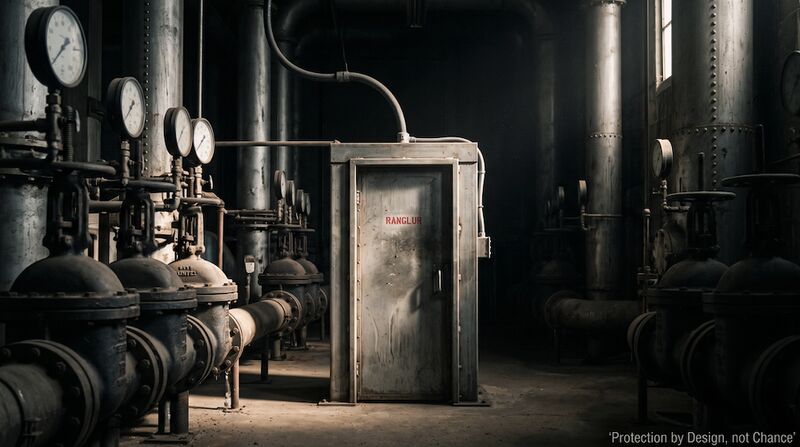
Five federal agencies recently issued one advisory.
Threat actors are using AI-generated scripts to attack the industrial controllers that run American water, energy, and manufacturing plants.
Twelve states. Confirmed. Water utilities forced off automation and back to running plants by hand. In one Atlanta-area system serving 300,000 people, pressure dropped, and a boil-water advisory went out.
The controllers were reached directly. Pumps. Valves. Pressure. In at least one case, the safety systems, the ones built to stop equipment from destroying itself, were switched off.
The agencies said the same thing to every operator of every controller. Treat this as yours.
It is.
Industrial controllers have always been attackable. What changed is the price of the attack.
For twenty years, most plants were not defended by their firewalls. They were defended by difficulty. Writing a working exploit against an industrial controller took rare skill, rare patience, and rare knowledge of the physical process. That difficulty was the moat.
AI drains the moat.
When a model can draft the reconnaissance and the controller-specific script, dressed to look like legitimate software, the rare skill becomes a cheap prompt. The attacker’s marginal cost is now a sentence. Yours is still a salary.
No defense that scales with human effort wins that race. You cannot hire fast enough. You cannot write signatures fast enough. You cannot watch fast enough.
So the question stops being how well you detect the attack. It becomes whether the attack can reach the controller at all.
The advisory listed three fixes. Two are hygiene. One is architecture.
Inventory the controllers. Patch them. And remove them from direct internet access.
The third one is the whole game. A controller exposed to the internet is a muscle with a phone number. It does not matter how clever the exploit is if there is no path to reach it.
The technology that holds in this era was built for the plant floor, not borrowed from the office.
The one-way wall, a hardware gateway that lets data leave the plant, but physically cannot carry a command back in. Not configured to be one-way. Incapable of it. An AI can write a perfect exploit. It has nowhere to send it.
The independent safety layer, a last line that answers to nothing the attacker can reach. A controller commanded to destroy itself is told no, and cannot be argued out of it.
OT-native monitoring, a watch that speaks the plant’s own language and sees the attack as a physical anomaly, not a signature it has to recognize in advance.
None of these win the argument with the attacker. They remove the argument.
The best protection was never the one that watched the attack and beat it. It was the one that made sure the attack was never in the room.
Protection by Design, not Chance