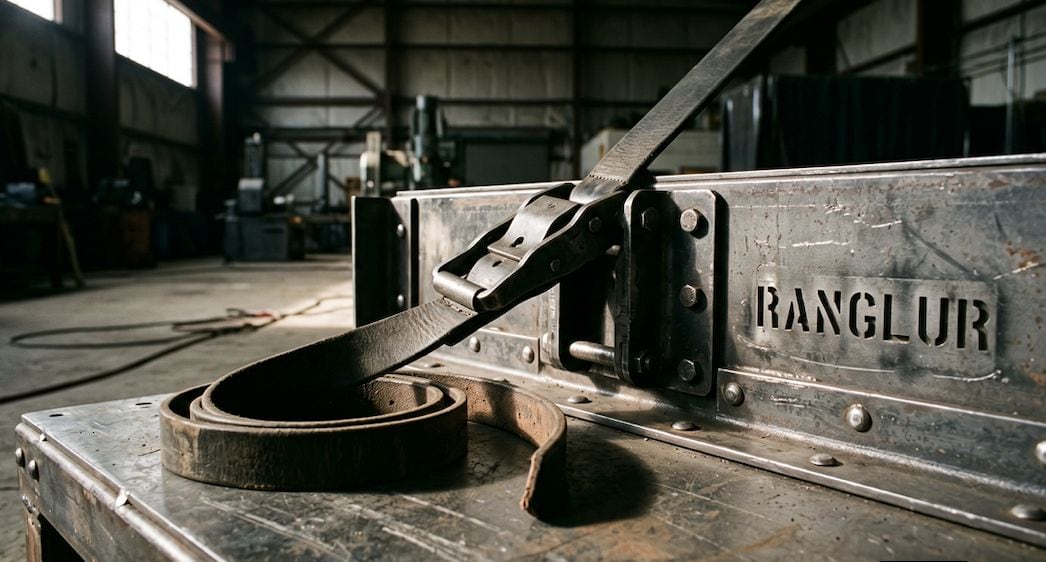
Two seat belts. Same stated job. Opposite engineering.
Your car has a passenger’s three-point harness across the shoulder and lap.
An aircraft has a passenger’s single lap belt with a center-release lever. The design cars abandoned in the 1970s.
The aircraft belt is deliberately the lesser mechanism. It’s also the correct one. If you measure protection by how much it restrains, the rest of this will read as heresy.
They are not two attempts at the same problem. They answer two different threats.
The car belt answers horizontal collision. The aircraft belt answers vertical displacement from turbulence, the sudden drop, the body thrown against the overhead bin. A shoulder harness does almost nothing against that. And in the catastrophic case, the airframe striking terrain at a speed no belt changes the outcome anyway.
So the aircraft belt is built to three disciplines most travelers never notice. It’s matched to the survivable, frequent threat, not the rare, unsurvivable one. You armor the failure mode you can actually change. It releases instantly. One lever, center-mounted, operable in darkness and smoke, by the passenger or a rescuer, with nothing to untangle. A restraint that cannot let go at the right instant is not protection. It’s what traps you at the door.
And where the environment changes, so does the standard- proven, not asserted. Pods, cockpits, and jump seats get shoulder belts because their geometry creates a different threat. The regulator crash-tests the requirement before imposing it.
This is the whole discipline of protective infrastructure in a single buckle.
Protection technology is not measured by how much it restrains. It’s measured by how precisely it matches the real failure mode of the place it serves, and by whether it releases the person it protects when survival demands it.
The common failure in the physical security field is the car belt bolted onto the airplane. The maximal camera grid. The maximal access stack. The maximal restraint. Impressive, expensive, and aimed at the wrong axis of attack. It feels like more security. It’s actually less protection.
Hold what must be held. Release what must be released.
Protection by Design, not Chance.