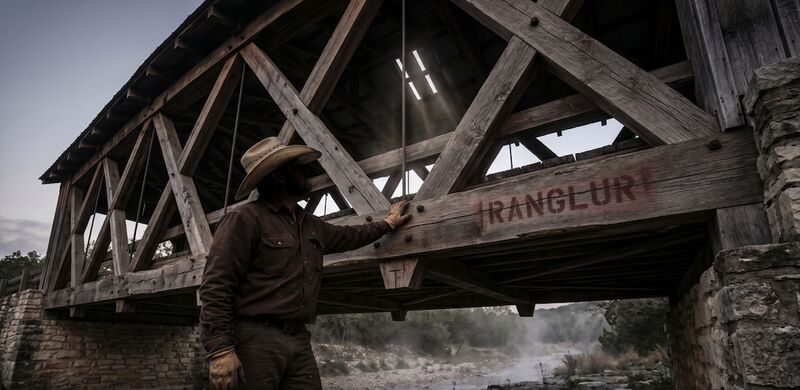
An uncovered wooden bridge lasted ten to twenty years. A covered one could last two hundred.
The cover is what people remember. The cover is not what carried the bridge.
Underneath the roof was a truss system. Beams arranged in triangles. Load distributed by geometry, not by appearance.
The covering kept the timber dry. The truss kept the weight from breaking it.
Without the truss, the roof was decoration. Without the roof, the truss rotted out.
The same logic governs physical protection infrastructure for enterprises.
Visible security is often mistaken for the protection itself. Cameras on the wall. Officers at the lobby. Logos on the door of the response vendor.
These are the covering. They reduce exposure to certain conditions. They do not carry the load.
The truss is the part that is rarely seen.
Access architecture that survives an executive turnover. Integration across physical, technology, and telemetry collection functions that does not collapse when one capable individual leaves.
Procedures that hold when the original author is gone. Redundancy that is documented, tested, and dull.
When an enterprise fails, the covering is almost always intact. The truss had given way years earlier. No one had reason to look.
Building one of these bridges took a village. Sawyers. Timber framers. Stonemasons.
Not because the work was dramatic. Because no single trade could produce a load-bearing crossing alone.
The same is true at the enterprise scale. No single vendor service, no single technology, no single discipline produces Protective Infrastructure on its own. It is composed.
Ten thousand covered bridges were built in this country. Fewer than a thousand remain. Most were lost to floods, fires, or neglect. Usually neglect.
The covering bought time. It did not buy permanence. Permanence required continuous stewardship long after the structure was first praised.
This applies once an operation is large enough that visible security alone no longer accounts for the load being carried.
Below that, decoration always seems sufficient. Above it, the truss either exists or it does not.
What most enterprises call “security” is often still largely ornamental.
It photographs well, satisfies checklists, and signals intent, but it does not carry consequences when conditions change. Load-bearing protection is quiet, systemic, and often invisible to those not trained to look for it.
The real failure point isn’t the absence of controls. It’s the absence of continuity, integration, and structural design thinking across those controls.
Bridges don’t fail the day they collapse. They failed the day the truss began to weaken and separate, with no one accountable for noticing.
Protection, at scale, is less about what you install and more about what you’ve engineered to endure.